WrangleAI helps businesses make the SLM vs LLM decision automatically, and this guide explains why that decision matters so much for AI spend. Every time an application sends a request to a language model, a choice is being made, whether anyone notices it or not, about which model actually handles that task.
Many teams default to the largest, most capable model for everything, simply because it is already wired into their code. This guide will walk through what SLM vs LLM really means, when a small model can genuinely save a business a large share of its AI costs, and how WrangleAI makes this choice automatically so nobody has to think about it request by request.
Key Takeaways
- SLM stands for small language model, and LLM stands for large language model, and the SLM vs LLM choice is really a question of matching task difficulty to model size.
- Small models are often ten times cheaper or more per token than large frontier models, and sometimes far more than that.
- Independent industry analysis in 2026 found that businesses using a tiered approach, small models for routine work and large models for harder tasks, paid close to ninety percent less per token than those routing everything to a frontier model.
- Savings of sixty percent or more are realistic for many businesses once routine, repetitive tasks are moved to smaller models.
WrangleAI automates the SLM vs LLM decision through smart routing, so the right model is chosen for each task without any manual work.
- What Do SLM and LLM Actually Mean?
- Why the SLM vs LLM Question Matters for Cost
- How Much Can Small Language Models Actually Save?
- When a Small Language Model Is the Right Choice
- When You Still Need a Large Language Model
- The Risk of Getting SLM vs LLM Wrong
- How to Decide Between an SLM and an LLM for Each Task
- How WrangleAI Automates the SLM vs LLM Decision
- FAQs
- WrangleAI Makes the SLM vs LLM Decision for You
What Do SLM and LLM Actually Mean?
An LLM, or large language model, is a model such as GPT-5 or Claude Opus, trained on huge amounts of data and built to handle a wide range of complex tasks with strong reasoning.
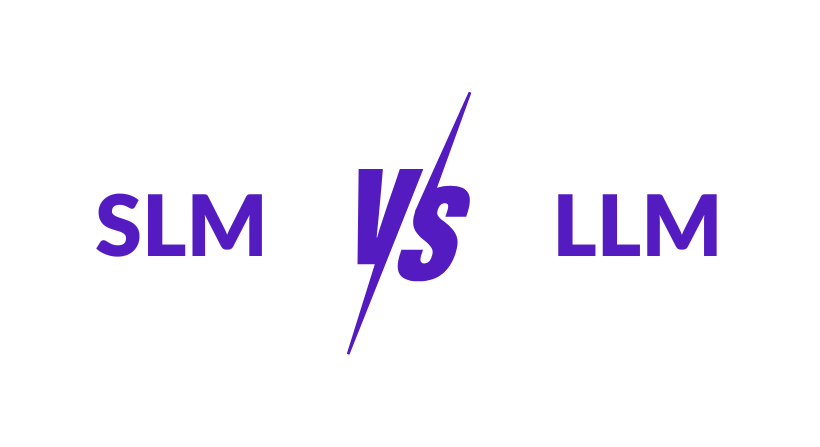
An SLM, or small language model, is a smaller, more focused model that uses far fewer resources to run. It cannot match a large model on every task, but for simpler, more repetitive jobs, it can often produce results that are just as good, at a much lower cost. The SLM vs LLM decision is really about picking the right size of tool for each specific job, rather than assuming bigger is always better.
Why the SLM vs LLM Question Matters for Cost
Language models are billed by the token, and the price difference between small and large models is often far bigger than people expect. A large frontier model can cost many times more per million tokens than a smaller model built for simpler tasks.
When every request in an application is sent to the same large model, regardless of how simple the task is, that price gap turns into a huge amount of wasted spend over time. This is exactly why the SLM vs LLM question has become one of the biggest levers a business has for controlling its AI bill.
How Much Can Small Language Models Actually Save?
The honest answer is that savings depend on the mix of tasks a business runs, but the numbers involved are large enough to take seriously.
Real World Cost Gaps Between Small and Large Models
Pricing across the market in 2026 shows small models running many times cheaper than frontier models on a per token basis, with some comparisons showing a gap of well over one hundred times on certain model pairs. Even a modest version of this gap, applied across a large volume of routine requests, adds up to a significant saving.
Where the 60% Figure Comes From
One widely cited 2026 industry analysis of enterprise API traffic compared two approaches. Businesses that routed every task to a frontier model paid a blended cost of around eighteen dollars per million tokens. Businesses that used a tiered approach, sending routine work to small models and only harder tasks to frontier models, paid closer to two dollars per million tokens, on the same workload.
That works out to a saving of close to ninety percent in that particular study, though real results will vary depending on how much of a business’s traffic is genuinely routine. A saving in the region of sixty percent is a realistic, achievable benchmark for many businesses once a reasonable share of simple tasks is moved to smaller models, even before reaching the higher end of what is possible.
When a Small Language Model Is the Right Choice
Small models tend to work well for tasks that are repetitive, well defined, and do not require deep reasoning. Simple classification, short summaries, basic customer support replies and routine data extraction are all common examples where a smaller model can match a large one closely enough that the cost saving is worth taking.
These tasks often make up a large share of an application’s total request volume, which is exactly why routing them to a smaller model has such a big effect on overall spend, even though each individual request is small.
When You Still Need a Large Language Model
Some tasks genuinely need the extra reasoning power that a large model provides. Complex analysis, multi step reasoning, nuanced writing and tasks with a high cost of getting things wrong are usually worth the extra spend on a frontier model.
The goal of the SLM vs LLM decision is never to remove large models altogether. It is to stop using them by default for tasks that never needed that level of power in the first place, while still reaching for them when the task genuinely calls for it.
The Risk of Getting SLM vs LLM Wrong
Getting this decision wrong in one direction means overpaying for simple tasks that a smaller model could have handled just as well, which quietly drains a business’s AI budget over time.
Getting it wrong in the other direction, by pushing a genuinely hard task onto a small model to save money, can lead to poor quality results, more mistakes, and extra work fixing problems later. This is why the decision needs to be made carefully, task by task, rather than as a single blanket rule applied everywhere.

How to Decide Between an SLM and an LLM for Each Task
A useful starting point is to look at how much reasoning a task genuinely requires, and how costly a mistake would be if the model got it wrong. Routine, low risk tasks are strong candidates for a small model, while complex or high stakes tasks usually justify a large one.
In practice, most businesses find it difficult to make this call correctly for every single request by hand, especially as the number of requests grows. This is exactly the kind of decision that benefits from being automated rather than left to individual developers to judge case by case.
How WrangleAI Automates the SLM vs LLM Decision
WrangleAI includes smart routing that makes the SLM vs LLM decision automatically, without requiring any change to an application’s existing code. Simple, routine requests are sent to smaller, cheaper models, while harder tasks are still sent to more capable ones.
This sits inside a wider control plane, so alongside the routing itself, a business also gets a shared dashboard showing exactly how much is being spent on small models versus large ones, along with budgets, alerts and governance across every provider. In other words, WrangleAI takes the SLM vs LLM decision out of individual developers’ hands and turns it into a consistent, business wide policy.
FAQs
What is the main difference between an SLM and an LLM?
An SLM is a smaller, more focused model that uses fewer resources and costs less to run, while an LLM is a larger model built for a wider range of complex tasks, usually at a higher cost per token.
Can small language models really save 60% on AI costs?
Yes, for many businesses. Industry analysis in 2026 found savings approaching ninety percent when routine tasks were moved to small models, so a sixty percent saving is a realistic outcome once a reasonable share of simple tasks is routed away from large models.
Do small language models produce lower quality results?
Not necessarily, for tasks that match their strengths. Small models can perform close to large models on simple, well defined tasks, though they generally fall behind on tasks that need deep reasoning or nuanced judgement.
How does WrangleAI decide between an SLM and an LLM?
WrangleAI uses smart routing to send each request to the most cost effective model automatically, based on the nature of the task, without requiring any changes to the application’s code.
Is it risky to rely on small language models for customer facing tasks?
It depends on the task. Simple, low risk interactions are usually safe to route to a small model, while complex or sensitive customer interactions are generally safer left with a larger model.
WrangleAI Makes the SLM vs LLM Decision for You
The SLM vs LLM decision is one of the simplest, highest impact ways for a business to cut its AI costs, yet it is also one of the easiest to get wrong when it is left to manual judgement across dozens or hundreds of requests a day.
WrangleAI removes that guesswork by routing each request to the right model automatically, backed by a shared dashboard, budgets and governance across every provider your business uses. If you are ready to stop overpaying for simple tasks that never needed a large model, visit wrangleai.com and request a free demo today. WrangleAI is ready to turn the SLM vs LLM decision into a real, measurable saving for your business.