AI models continue to grow stronger and more widely used. While this brings new products and faster workflows, it also raises questions about energy use and environmental impact. Many organisations now ask how much energy their AI systems consume and what this means for sustainability goals.
To help answer these questions, WrangleAI has introduced a new feature called the WrangleAI Emission Estimator. This feature gives teams visibility into the carbon footprint linked to their AI usage. It allows users to compare models, track trends and make more informed decisions about which models to use for different tasks.
In this guide, we explain what the WrangleAI Emission Estimator does, why it matters and how teams can use it to support better sustainability practices.
- Why Environmental Impact Matters in AI
- What Is the WrangleAI Emission Estimator
- A Helpful Way to Think About It
- Why Estimates, Not Exact Measurements
- Understanding Confidence Levels
- What Affects Accuracy
- What You Can Do With This Feature
- What This Feature Is Best Used For
- Frequently Asked Questions About the Emission Estimator
- Who Benefits From the Emission Estimator
- Best Practices for Using the Feature
- Why This Matters in the Bigger Picture
- The WrangleAI Advantage
- Conclusion
Why Environmental Impact Matters in AI
AI workloads use energy. As usage grows, energy usage scales with it. The more tokens processed, the more data moved and the more compute required. Many organisations want to track AI emissions for three main reasons:
- Sustainability and ESG goals
- Internal reporting and transparency
- Efficiency and optimisation
Even if the emissions are small on their own, they become meaningful when AI workloads run at scale across teams and products.
What Is the WrangleAI Emission Estimator
The WrangleAI Emission Estimator is designed to show users the estimated carbon emissions linked to their AI model usage. It gives visibility into the environmental cost of each model request and helps teams compare different models based on efficiency and output.
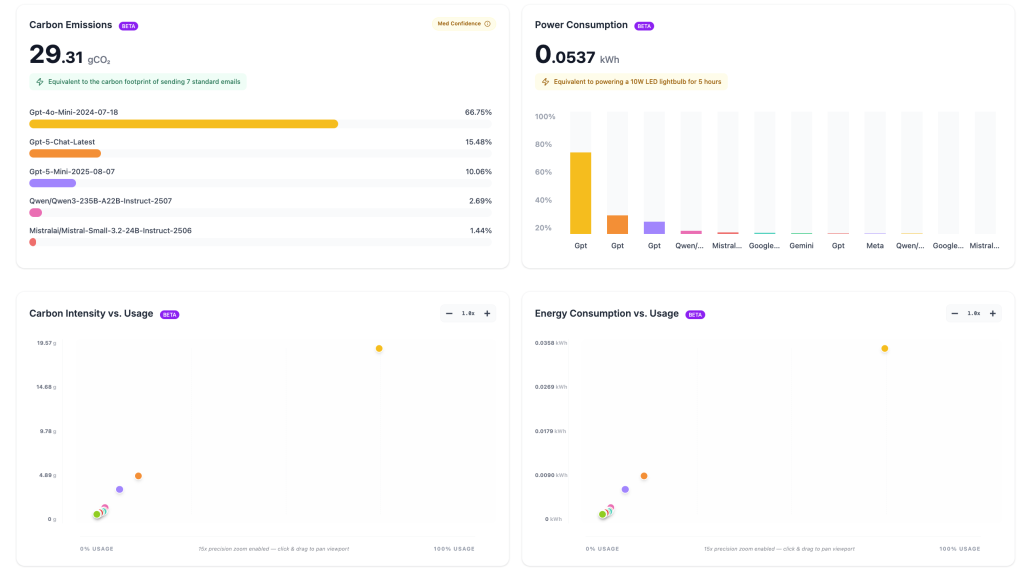
The goal is not perfect precision. The goal is to create awareness and help teams make informed choices based on real signals.
A Helpful Way to Think About It
Two helpful comparisons explain how this feature works:
The Prius Effect
Hybrid cars often show real time fuel usage on the dashboard. When drivers see how their actions affect fuel efficiency, they naturally adjust their driving style. Small choices add up to better outcomes.
In a similar way, when teams see the emissions linked to their AI usage, they tend to choose more efficient models or adjust workloads to waste less compute. Visibility creates better habits.
Like a Wrist-Based Heart Rate Monitor
A wrist-based heart monitor is not as precise as a medical sensor, but it is still useful. It helps track trends, compare effort and gain a clear sense of improvement over time.
The WrangleAI Emission Estimator works the same way. It may not give exact science-grade numbers, but it gives consistent benchmarks that help teams compare models, track trends and make better decisions.
Why Estimates, Not Exact Measurements
AI models run on infrastructure owned by cloud providers. Companies do not have direct access to:
- Data centre hardware data
- Real time power usage
- Energy source mix for each GPU
- Live cooling consumption
Because of this, exact numbers are not possible. Instead, WrangleAI uses the best available public data sources, including:
- Regional grid intensity
- Industry model benchmarks
- Provider region information
- Known cloud efficiency data
The estimates are transparent and consistent so teams can rely on them for comparison and improvement.
Understanding Confidence Levels
Each estimate includes a confidence level that reflects how much information is known for that request.
High Confidence
Used when both the model and provider region are known. These results are usually within a tight range and are ideal for comparison.
Medium Confidence
Used when partial information is available, such as model details without location or location without model.
Low Confidence
Used when very little information is available. These estimates are less precise but still more useful than having no visibility.
Confidence levels guide interpretation so teams understand what they can trust and how to apply it.
Quick link: What If HubSpot Used WrangleAI? Smarter AI, Lower Spend, More Control
What Affects Accuracy
Several factors can improve accuracy:
- Known model families
- Known hosting providers
- Known region or data centre
- Published benchmarks
Accuracy decreases when information is not disclosed by providers.
The key point is that relative comparisons remain strong even if absolute values have a margin of error. If Model A uses 10 times more emissions than Model B, that relationship is meaningful even if the exact numbers vary.
What You Can Do With This Feature
The WrangleAI Emission Estimator can be used for several practical tasks.
Compare Models
Teams can compare different models and see which ones deliver similar results for less environmental cost.
Track Emission Trends
Teams can measure improvement over time as they adopt more efficient workloads or tune their systems.
Set Internal Sustainability Goals
Sustainability teams can set goals, track progress and report outcomes with transparency.
Support Decision Making
Teams can use emissions data as part of model routing rules or procurement decisions.
What This Feature Is Best Used For
This feature works well for:
- Model comparisons
- Trend tracking
- Efficiency choices
- Sustainability awareness
- High level reporting
It is not intended for:
- Formal legal compliance reporting
- Scientific grade carbon calculations
- Carbon offset finance work
For those tasks, organisations typically need specialised carbon accounting support and verified reporting data.
Frequently Asked Questions About the Emission Estimator
Can the estimates be trusted?
Yes. They are reliable for comparison, decision making and trend analysis. They are not meant for exact regulatory reporting.
Why do emissions change across similar tasks?
Several factors influence emissions, such as token count, model choice and regional energy sources.
Can this support sustainability reporting?
It can support drafting and input, but for formal reporting most organisations will add third party verification.
Will accuracy improve over time?
Yes. As providers release more data and benchmarks improve, estimates become more precise.
Who Benefits From the Emission Estimator
The feature benefits several groups inside an organisation:
Engineering Teams
Engineering teams can choose efficient models without guesswork.
Finance and Sustainability Teams
Finance and ESG teams gain visibility into AI’s environmental impact.
Leadership
Leaders gain clarity on how AI adoption aligns with sustainability goals.
Procurement Teams
Procurement can use emissions data as part of vendor and model selection.
Best Practices for Using the Feature
To get the most value from the Emission Estimator, teams should:
- Compare models for the same task
- Track emissions over time
- Look at confidence levels
- Use trends for planning
- Combine emissions with cost insights
The last point is important because emissions and cost are often linked to the same inefficiencies.
Why This Matters in the Bigger Picture
As AI grows, companies face two major questions:
- How to control financial cost
- How to control environmental cost
Both are linked to efficiency, routing and model selection. Companies that ignore emissions now will pay higher financial and ESG costs later.
Just as cloud computing created cloud FinOps, AI is creating a new space for AI FinOps and AI sustainability insights. The organisations that invest early in visibility will scale with fewer surprises.
The WrangleAI Advantage
The Emission Estimator is one part of the broader WrangleAI platform. WrangleAI helps teams:
- Track AI usage
- Control cost
- Compare models
- Route workloads
- Govern access
- Forecast spend
By adding emissions alongside cost and performance, WrangleAI gives teams a complete picture of AI efficiency. This supports responsible scaling without slowing innovation.

Conclusion
AI adoption is accelerating. With this growth comes the need for better visibility into both financial and environmental impact. The WrangleAI Emission Estimator helps teams understand emissions, compare models and make informed sustainability decisions.
It does not aim for perfect precision. It aims for practical awareness, better decision making and positive habit changes. Over time, this leads to better outcomes for teams and the environment.
If your organisation wants to scale AI with clarity, sustainability and control, WrangleAI gives you the tools to do it with confidence.